
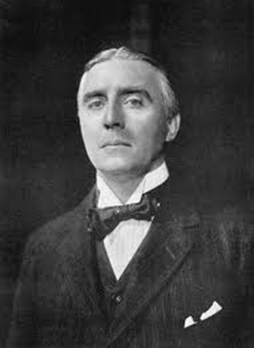
Edward Hugh Sothern
06/12/1859 – 28/10/1933
An American actor who specialized in dashing, romantic leading roles and particularly in Shakespearean roles.
‘When I had reached the age of eight, it was decided that I must go to a boarding-school. My father used to hunt. One day he went to a meet at Dunchurch, a little village three miles from Rugby in Warwickshire. He in his red coat, two or three horses, and the groom. During the run he found that he and one other well-mounted man were far ahead of the field. They began to talk, and it developed that the other sportsman was a schoolmaster, one Alfred A. Harrison, who had just started a school for small boys at Dunchurch Lodge. “Good,” said my father, as they took a fence together, “I’ll send you my boy.” A few days later I was there, taking a tearful farewell of my mother. I was for six years at that school, and when I left it I took my brother Sam up, and he was there six years, too. We are neither of us scholars, but we would not barter those dear years for much learning. I never go to England but I go to Dunchurch. The school no longer exists. Some years since, on one of my visits, I viewed the charred remains of the old house. A large tree was growing in the middle of the room which used to be my dear old master’s study. Another large tree grew in the room into which my mother had taken me at eight years of age to confront the spirit of learning; it grew from the middle of the floor, and its branches went out at the windows – the “Tree of Knowledge,” I said to myself. I stood and looked at it for an hour, and I lived over again all the love and care and happiness I had known in that house, and I was quite sure that every leaf on that tree was a blessing from the heart of some little child who has found love and shelter under that fallen roof. Then I went to the Dun Cow, the village inn, and I sat in the tap-room after a meal and said to a beer-bibber: “Oh, yes, I was at school here.” There is a pair of stocks outside the Dun Cow. I have seen a man in those stocks, the one bad man who had passed that way in half a century. So, I looked at the stocks, and I looked at the church tower whence I had heard the moping owl to the moon complain, and I looked at the cottage which legend declares was the rendezvous of Guy Fawkes and his fellow conspirators, and I looked at the “Tuck Shop” across the street, and I felt very lonely. Such dear, kind fellows were our four masters! And our drawing-master! When I went to take my brother Sam to this school, the drawing-class was in session. I had just gone on the stage. At thirteen years the master had some hopes of me as a painter. “Hello,” said he, “how is the art.” “Oh, I have given it up,” said I, “I have taken to acting.” “Traitor,” said he, slowly and sadly, and he turned away. He was a poor, very poor man of about fifty. He walked three miles to Dunchurch and three miles back to Rugby twice a week to give little boys lessons in drawing. He wore a slouch-hat and a cropped beard, and he sang all the time. I can’t walk far without being tired, and I never sing at all. Well, he gave me a prize for drawing – “Self-Help,” by Smiles, a book that I read with delight; it has helped me a good deal. Mr. Harrison said to us: “What you know is much. What you are is more.” Whenever we told tales of each other, whenever we did any small thing that was punishable, Mr. Harrison would say: “Do you think a little gentleman would do that?” We did not think so, and we felt it, and we said nothing, but thought much. Since they have reached manhood, I have met many of the boys in that school. I have never met one who was not a man of character, and I have met some who were men of distinction. Soldiers, lawyers, doctors, all professions. But while they ran and while they ate, they had in their eager little heart’s examples of sweet and kind nobility, daily and hourly before them in the persons of this dear master and his wife and aids, that have moulded many of them in the years that have since come. We had our own separate gardens at this school. We delved and we garnered, and we were allowed to have our produce cooked and served. Whenever the hounds were in the village, a boy, usually the head boy (almost ten or eleven years old), would say after breakfast, “Half-holiday! Three cheers for Mr. Harrison!” We knew Mr. Harrison was eager for the fray. “You owls! go on, away with you.” And away it was. Such red blood dashing through such young hearts, such cries, such flying over hedges, such friendships, such vows, such memories! Was not my father wise to know that a schoolmaster who could ride gamely to hounds, must be a good school master? Greek! I learned none. Latin, less. Often have I bewailed this loss. But there has been something else, of no value – of all value. Not a penny in it. Hard to explain. But it takes me back to Dunchurch every year and will do so till I die.
Friends of Dunchurch, a charity formed on 6th September 2018 by like-minded residents who love Dunchurch and its heritage and wish to protect and enhance its environment in order to make the village a better place to live in, work in and visit.
CONTACT US
Email: friendsofdunchurch@gmail.com
Village Green House, The Green, Dunchurch CV22 6NX